 Open Room Summit
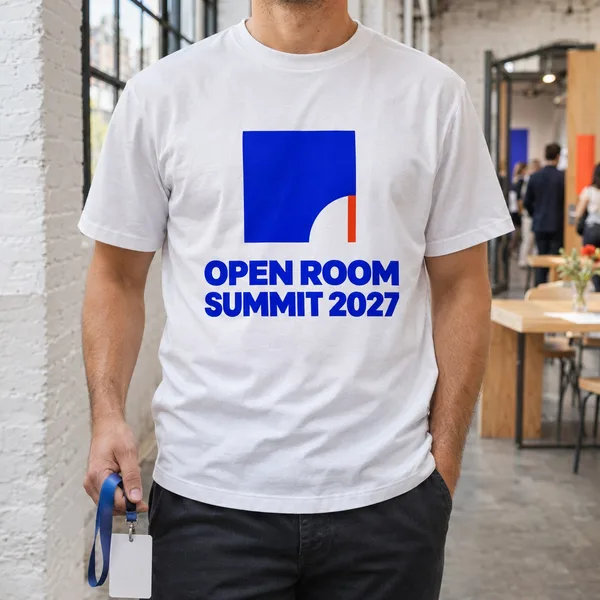
Why event merch usually ends as a box in someone's garage
A conference t-shirt is normally ordered in bulk. Screen printers work in runs, so most set a minimum per design, charge setup for each ink color and want the order weeks before doors open. You pick the quantity and the size split before you know who is coming.
Then the run meets the room. The mediums sell out before lunch on day one, the XXLs go back in the van, and whoever staffed the table missed half the sessions. Attendees who decide they want the shirt on the flight home have nowhere to buy it. The edition was limited by logistics, not by design.
Print on demand reverses the order of events. You open a store when ticket sales open, put the link in the confirmation email, and show a QR code on badges and slides during the event. Each attendee picks a size and pays; we print that one item in their region and ship it to their door. You keep the store open while people are still posting photos, then close it. Nothing was bought in advance, so nothing is left.
Event merch ideas that work without a merch table
Six ways organizers use a store that has no boxes behind it.
Sell with the ticket
Put the store next to ticket checkout — people are already in a spending mood and know the date.
Sell during the event
A QR on the badge, the screen and the program. Attendees order from their seat and get it at home.
Sell after it ends
The nostalgia window lasts about two weeks. Keep the store open and catch it.
Speaker and staff kits
Prepaid links for speakers, volunteers and sponsors — each picks their own size. Reward →
Edition merch that stays limited
A design that exists only for this year. Nothing is left over to discount later.
International attendees
Printed near each buyer, so an attendee from another continent is not a shipping problem.
How to sell event merch in four steps
Live before your next ticket release. No quote, no size spreadsheet, no pallet.
Design the edition
Year, city, theme, the lineup on the back. Editions are what make event merch collectible. The app places your art on the products and renders the photos, so there is no sample order.
Open the store with ticket sales
Pick products and set prices; the production cost is shown next to each one. Put the link in the ticket confirmation email and on the event site. Early buyers wear it to the event.
Put QR codes on site
Badges, slides between talks, the program, the photo wall. The code points to your store link. No merch table, no cash box, no queue.
Keep it open after
Orders are printed near each buyer and shipped with tracking to 100+ countries. Close the store when sales stop, not when the venue does. Your margin lands in your balance.
A bulk order before the event vs. a Merch5 store for it
| Bulk order from a print shop | Merch5 store for the event | |
|---|---|---|
| Minimum order | Usually a minimum per design; many screen printers start at 12 to 48 pieces | One. Each item is printed after it is paid for |
| Money up front | The whole run, paid weeks before doors open | $0. Printing and shipping come out of each paid order |
| Sizes | A size split guessed from registration data | Each attendee picks their own |
| Leftovers | Unsold boxes go home with the team or get discounted | None. Nothing exists until it is ordered |
| Selling window | The hours the merch table is staffed | From ticket sales to weeks after the closing session |
| On site | Table, staff, card reader, queue | A QR code on the badge, the slides and the program |
| Attendees from abroad | Carried home in a suitcase | Printed near the buyer, shipped to 100+ countries |
| In hand on the day | Yes. That is what the boxes are for | No. Each order ships to the buyer's address |
| Price per shirt | Lower per unit on big runs, as long as they sell | $14.45 to print a white tee, charged only on sold items. The buyer pays shipping |
Print shop minimums, setup fees and lead times vary; ask yours for an itemized quote. If every attendee gets a shirt at registration, a bulk run is the right tool, and a Merch5 store can sell everything else next to it.
Bulk run, group pre-order or on demand: which fits your event
Three common routes and where each one stops.
Bulk run from a screen printer
The lowest price per shirt on large runs, and the only way to hand every attendee a shirt at registration. You pay for the whole run up front and own whatever does not sell.
Group pre-order or batch campaign
Group order forms and campaign sites such as Custom Ink or Bonfire collect sizes and payments first, then print one batch when the window closes. That fixes the guessing. Buyers who show up after the window wait for the next batch, where there is one.
Merch5
A store with no window and no minimum. Each order is printed when it is paid and shipped to the buyer in 100+ countries. The trade-off is plain: nobody carries the shirt out of the venue the same day.
Free to set up. Paid out of orders you already received.
A bulk run is a bet placed before the event. Here printing and shipping are charged from each order after the attendee pays, and everything above cost is yours. An edition that sells four shirts made four margins and no loss.
Need branded packaging and inserts, or a custom setup? That lives on the paid plans. Everything described on this page does not.
What a t-shirt actually costs
Which events sell merch this way
Conferences and summits
An edition tee per year and a design for the speakers. Send speakers, sponsors and volunteers a prepaid link so each picks their own size. Prepaid merch links
Festivals and gigs
Lineup shirts keep selling the week after, when the photos are up. A link in the thank-you email and the Instagram bio catches that. Sell from your Instagram link
Races, tournaments and meetups
Finisher designs, team names, the bracket on the back. Run one store per event; an account holds as many as you need. All seven ways to sell
Same setup, different room
One catalog, one production network, one dashboard. The store works the same way for every audience.
Event merch questions
No. The minimum is one. Each item is printed after it is paid for, so a 60-person meetup and a 6,000-person conference use the same setup.
On-demand printing ships to the buyer, so same-day handover at the venue is not the model. Most organizers sell the edition online and skip the merch table entirely. If people should wear it on the day, open the store with ticket sales so early orders arrive before the event.
Per shirt, usually yes on large runs, because a screen printer's unit price drops with volume. Per event, often no: you pay nothing for shirts that do not sell and nothing for a staffed table, storage or shipping leftovers home. A white tee costs $14.45 to print; at a $34 price the $19.55 difference is yours.
Yes. Unlimited stores per account, each with its own design, link and analytics.
Send each of them a prepaid gift link. The recipient picks size, color and delivery address, and you pay only for gifts that are actually claimed.
Each order is routed to the production partner closest to the buyer and shipped with tracking to more than 100 countries, so nobody has to fit a hoodie into a carry-on.
Whenever you like. The nostalgia window after an event lasts about two weeks, so many organizers keep the store open that long and then retire the design so the edition stays limited.
Nothing. Building the store, generating mockups and hosting are free. We charge printing and shipping out of an order only after your customer has paid for it.
We do. Each order is routed to the production partner closest to the buyer and ships with tracking to more than 100 countries. Print and delivery problems are on us, not on you.
Print and delivery problems are on us, not on you. Returns are easy within 14 days, so your customer stays happy.
Your margin adds to your balance in the dashboard. We pay it out automatically every two weeks, or right away when you ask, once $50 is available. You set the retail price, so you decide what that margin is.
Nothing to order, nothing to carry, nothing left over.
Open the store before tickets go on sale and see what your attendees buy.